Beyond Pixels: What If You Could Sense Someone Inside a Zone?
How millimetre-wave radar can tell whether someone is inside a defined area — without a camera, without light, and without creating a conventional image.
Imagine you need to know whether someone is standing in a particular area — at a machine, an entrance, a restricted aisle. The requirement sounds simple: “Tell me when someone enters this zone.”
The obvious answer is a camera. But then the questions begin. Where does the video go? Who can access it? What happens when the room is dark, dusty or full of steam? And do we really need an image just to know whether someone is there?
That is where radar becomes interesting. It sends radio waves out and listens for what returns, estimating distance, movement and direction. No photograph, no face, no video — and the processing runs on the edge device.

The file with nothing in it
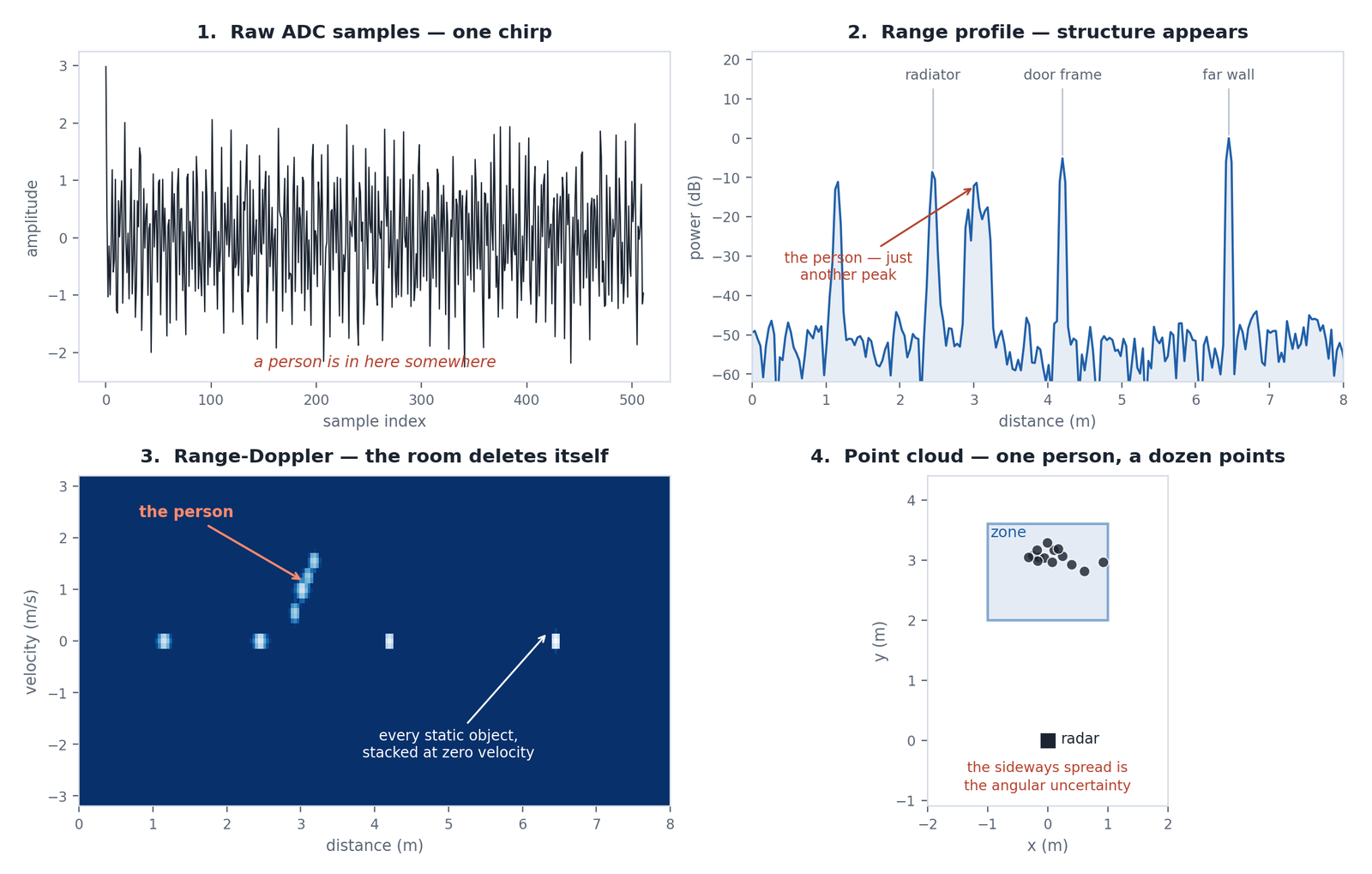
I opened my first raw radar capture expecting something recognisable: a person, a shape, a bright blob. Instead I saw samples inside chirps, chirps inside frames, across several receive antennas — and no person anywhere in it.
I wondered whether I had configured the radar incorrectly. I hadn’t. The person was there — just not visible the way a camera makes a person visible.
From echoes to a moving person
The principle is familiar from an echo: measure the delay and you get distance. Radar transmits a chirp, compares it with what returned, and an FFT turns the samples into a range profile.
Send chirps in quick succession and motion appears too. Changes from one chirp to the next carry velocity through the Doppler effect. Stationary objects concentrate around zero Doppler, allowing the processing chain to suppress much of the static clutter and emphasise moving targets.
Why direction is the hard part
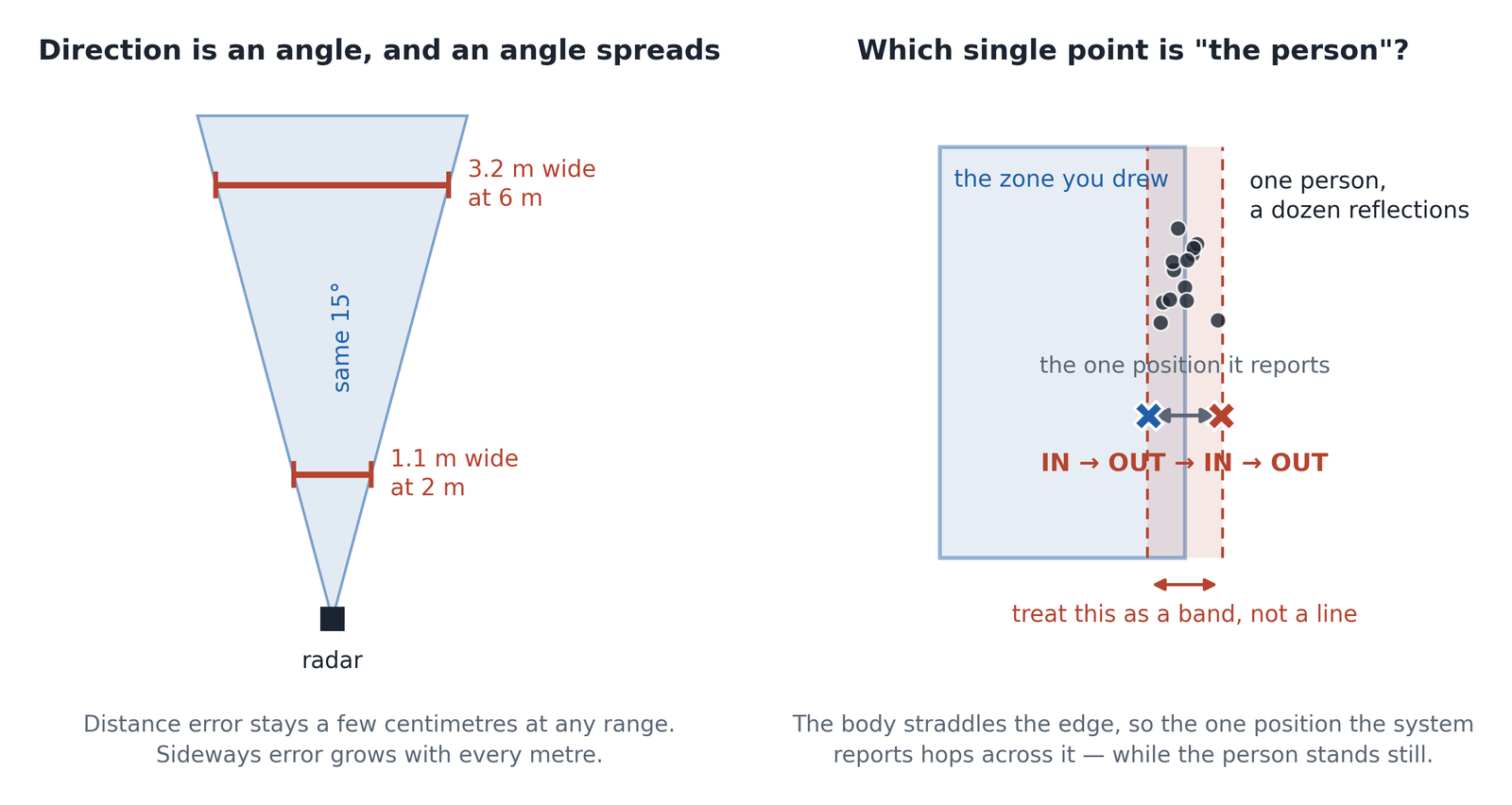
Radar can estimate distance with relatively fine resolution, but angular uncertainty becomes more significant farther from the sensor. Direction comes from comparing echoes across several antennas. The result is an angle — and an angle spreads. The same few degrees cover a small width nearby and a much larger width farther away. Radar sees sharply in depth, and softly across.
What happens when someone stands on the line?
The system worked. Step in: ON. Step out: OFF. Then someone stopped directly on the boundary. Suddenly: IN → OUT → IN → OUT.
One person is not one detection. The torso, head and limbs reflect separately, while the application needs a single answer. The software therefore collapses that cloud into one position. Near the boundary, some reflections fall inside and some outside. As the strongest reflections shift between frames, that reported position drifts across the line even when the person barely moves. Angular uncertainty makes the effect worse farther from the sensor.
The fix wasn’t a larger neural network. We stopped treating the boundary as a perfect line and treated it as a band. Inside that band, the system became deliberately reluctant to change its mind: several consistent frames before declaring IN, and stronger evidence before declaring OUT. That temporal smoothing and hysteresis turned a flickering demo into something the application could trust.
Sensing doesn’t always mean seeing
This processing approach relies heavily on motion to separate people from static clutter, so a person standing still and reading is a difficult case. Breathing provides micro-motion, but that signal can be weak in a busy environment.
The useful question was never “is radar better than a camera?” but “what information does the application actually need?” If the question is only whether somebody entered an area, an image may be more information than the decision requires.
A camera would have caught the perfectly still person. It would also have captured everything around them.
No pixels. No faces. No video. Just echoes, physics, and a surprisingly large amount of engineering in between.

Accuracy Isn’t Everything: What Deploying AI at the Edge Taught Me
For a long time, I thought one number was enough to evaluate a model. Then I had to run one on real hardware, in real time, and realized that accuracy alone doesn't tell the whole story.
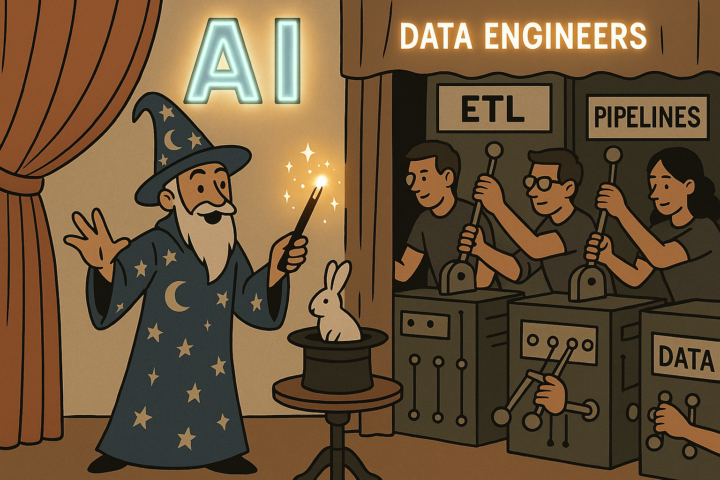
Data Engineering in AI: 80% Nobody Talks About
The AI revolution isn’t really about AI—it’s about data engineering wearing a shiny new suit.

Why Snowflake and Databricks Bet Big on Structured Data
In a world where GenAI, LLMs, and unstructured data dominate headlines, two major acquisitions recently made by industry giants signal a more grounded truth.